思考模式
DeepSeek 模型支持思考模式:在输出最终回答之前,模型会先输出一段思维链内容,以提升最终答案的准确性。
思考模式开关与思考强度控制
| 控制参数(OpenAI 格式) | 控制参数(Anthropic 格式) | 控制参数(Responses API 格式) | |
| 思考模式开关(1) | {"thinking": {"type": "enabled/disabled"}} | {"reasoning": {"effort": "none/low/high/max"}}(none 表示关闭思考模式) | |
| 思考强度控制(2) | {"reasoning_effort": "low/high/max"} | {"output_config": {"effort": "low/high/max"}} | |
(1) 思考模式默认打开,且 effort 默认为 high
(2) 用户设置的 effort 与模型推理 effort 映射表如下:
| 请求传入 effort | 实际映射 effort |
| minimal | low |
| low | low |
| medium | high |
| high | high |
| xhigh | high |
| max | max |
| ultra | max |
您在 OpenAI SDK 中使用 Chat Completion 设置 thinking 参数时,需要将 thinking 参数传入 extra_body 中:
response = client.chat.completions.create(
  model="deepseek-flash",
  # ...
  reasoning_effort="high",
  extra_body={"thinking": {"type": "enabled"}}
)
输入输出参数
思考模式不支持 temperature、presence_penalty、frequency_penalty 参数。请注意,为了兼容已有软件,设置参数不会报错,但也不会生效。
top_p 仅在思考模式下生效,有效取值范围为 0.95–1.0,低于 0.95 的取值会按 0.95 处理。在非思考模式下,该参数恒为 1.0,传入的值会被忽略。
在思考模式下,思维链内容通过 reasoning_content 参数返回,与 content 同级。在后续轮次的请求中,reasoning_content 是否需要回传、是否会被拼接进上下文,取决于请求是否携带 tools 参数:
- 若请求携带
tools参数:历史轮次的reasoning_content均应回传给 API,并会被拼接进上下文。详见工具调用。 - 若请求未携带
tools参数:reasoning_content无需回传;即使传入 API,也会被忽略,不会拼接进上下文。详见多轮对话拼接。
多轮对话拼接
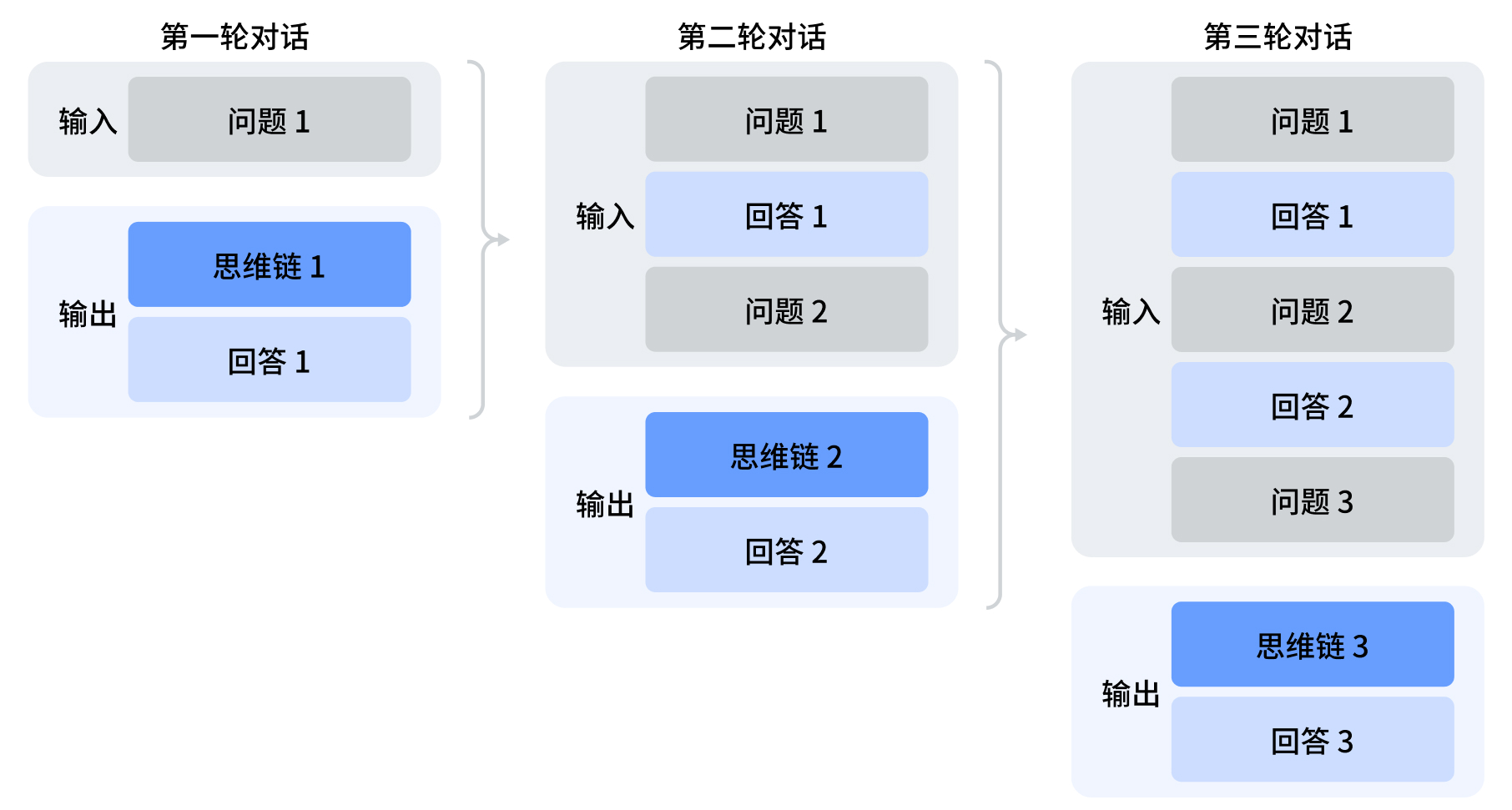
在每一轮对话过程中,模型会输出思维链内容(reasoning_content)和最终回答(content)。如果请求未携带 tools 参数,则在下一轮对话中,之前轮输出的思维链内容不会被拼接到上下文中,如下图所示:
样例代码
下面的代码以 Python 语言为例,展示了如何访问思维链和最终回答,以及如何在多轮对话中进行上下文拼接。
- 非流式
- 流式
from openai import OpenAI
client = OpenAI(api_key="<DeepSeek API Key>", base_url="https://api.deepseek.com")

# Turn 1
messages = [{"role": "user", "content": "9.11 and 9.8, which is greater?"}]
response = client.chat.completions.create(
    model="deepseek-flash",
    messages=messages,
    reasoning_effort="high"
    extra_body={"thinking": {"type": "enabled"}},
)

reasoning_content = response.choices[0].message.reasoning_content
content = response.choices[0].message.content

# Turn 2
# The reasoning_content will be ignored by the API
messages.append(response.choices[0].message)
messages.append({'role': 'user', 'content': "How many Rs are there in the word 'strawberry'?"})
response = client.chat.completions.create(
    model="deepseek-flash",
    messages=messages,
    reasoning_effort="high"
    extra_body={"thinking": {"type": "enabled"}},
)
# ...
from openai import OpenAI
client = OpenAI(api_key="<DeepSeek API Key>", base_url="https://api.deepseek.com")

# Turn 1
messages = [{"role": "user", "content": "9.11 and 9.8, which is greater?"}]
response = client.chat.completions.create(
    model="deepseek-flash",
    messages=messages,
    stream=True,
    reasoning_effort="high"
    extra_body={"thinking": {"type": "enabled"}},
)

reasoning_content = ""
content = ""

for chunk in response:
    if chunk.choices[0].delta.reasoning_content:
        reasoning_content += chunk.choices[0].delta.reasoning_content
    else:
        content += chunk.choices[0].delta.content

# Turn 2
# The reasoning_content will be ignored by the API
messages.append({"role": "assistant", "reasoning_content": reasoning_content, "content": content})
messages.append({'role': 'user', 'content': "How many Rs are there in the word 'strawberry'?"})
response = client.chat.completions.create(
    model="deepseek-flash",
    messages=messages,
    stream=True,
    reasoning_effort="high"
    extra_body={"thinking": {"type": "enabled"}},
)
# ...
工具调用
DeepSeek 模型的思考模式支持工具调用功能。模型在输出最终答案之前,可以进行多轮的思考与工具调用,以提升答案的质量。其调用模式如下图所示:
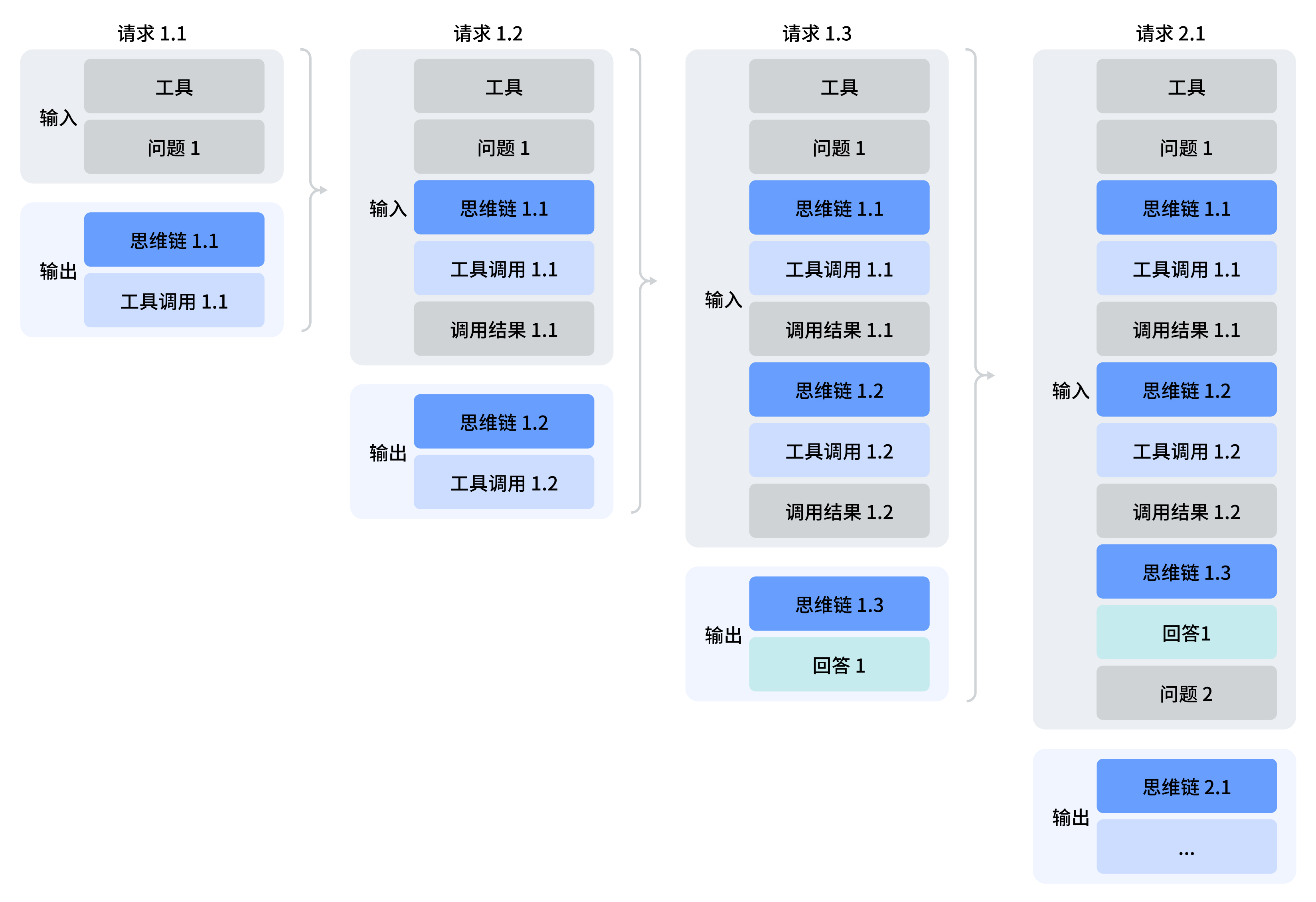
请注意,携带了 tools 参数的请求,在后续所有请求中,必须完整回传 reasoning_content 给 API——即使该轮模型未实际进行工具调用。若您的代码中未正确回传 reasoning_content,API 会返回 400 报错。正确回传方法请您参考下面的样例代码。
样例代码
下面是一个简单的在思考模式下进行工具调用的样例代码:
import os
import json
from openai import OpenAI
from datetime import datetime

# The definition of the tools
tools = [
    {
        "type": "function",
        "function": {
            "name": "get_date",
            "description": "Get the current date",
            "parameters": { "type": "object", "properties": {} },
        }
    },
    {
        "type": "function",
        "function": {
            "name": "get_weather",
            "description": "Get weather of a location, the user should supply the location and date.",
            "parameters": {
                "type": "object",
                "properties": {
                    "location": { "type": "string", "description": "The city name" },
                    "date": { "type": "string", "description": "The date in format YYYY-mm-dd" },
                },
                "required": ["location", "date"]
            },
        }
    },
]

# The mocked version of the tool calls
def get_date_mock():
    return datetime.now().strftime("%Y-%m-%d")

def get_weather_mock(location, date):
    return "Cloudy 7~13°C"

TOOL_CALL_MAP = {
    "get_date": get_date_mock,
    "get_weather": get_weather_mock
}

def run_turn(turn, messages):
    sub_turn = 1
    while True:
        response = client.chat.completions.create(
            model='deepseek-flash',
            messages=messages,
            tools=tools,
            reasoning_effort="high",
            extra_body={ "thinking": { "type": "enabled" } },
        )
        messages.append(response.choices[0].message)
        reasoning_content = response.choices[0].message.reasoning_content
        content = response.choices[0].message.content
        tool_calls = response.choices[0].message.tool_calls
        print(f"Turn {turn}.{sub_turn}\n{reasoning_content=}\n{content=}\n{tool_calls=}")
        # If there is no tool calls, then the model should get a final answer and we need to stop the loop
        if tool_calls is None:
            break
        for tool in tool_calls:
            tool_function = TOOL_CALL_MAP[tool.function.name]
            tool_result = tool_function(**json.loads(tool.function.arguments))
            print(f"tool result for {tool.function.name}: {tool_result}\n")
            messages.append({
                "role": "tool",
                "tool_call_id": tool.id,
                "content": tool_result,
            })
        sub_turn += 1
    print()

client = OpenAI(
    api_key=os.environ.get('DEEPSEEK_API_KEY'),
    base_url=os.environ.get('DEEPSEEK_BASE_URL'),
)

# The user starts a question
turn = 1
messages = [{
    "role": "user",
    "content": "How's the weather in Hangzhou Tomorrow"
}]
run_turn(turn, messages)

# The user starts a new question
turn = 2
messages.append({
    "role": "user",
    "content": "How's the weather in Guangzhou Tomorrow"
})
run_turn(turn, messages)
在 Turn 1 的每个子请求中,都携带了该 Turn 下产生的 reasoning_content 给 API,从而让模型继续之前的思考。response.choices[0].message 携带了 assistant 消息的所有必要字段,包括 content、reasoning_content、tool_calls。简单起见,可以直接用如下代码将消息 append 到 messages 结尾:
messages.append(response.choices[0].message)
这行代码等价于:
messages.append({
    'role': 'assistant',
    'content': response.choices[0].message.content,
    'reasoning_content': response.choices[0].message.reasoning_content,
    'tool_calls': response.choices[0].message.tool_calls,
})
且在 Turn 2 的请求中,我们仍然携带着 Turn1 所产生的 reasoning_content 给 API。
该代码的样例输出如下:
Turn 1.1
reasoning_content="The user is asking about the weather in Hangzhou tomorrow. I need to get tomorrow's date first, then call the weather function."
content="Let me check tomorrow's weather in Hangzhou for you. First, let me get tomorrow's date."
tool_calls=[ChatCompletionMessageFunctionToolCall(id='call_00_kw66qNnNto11bSfJVIdlV5Oo', function=Function(arguments='{}', name='get_date'), type='function', index=0)]
tool result for get_date: 2026-04-19

Turn 1.2
reasoning_content="Today is 2026-04-19, so tomorrow is 2026-04-20. Now I'll call the weather function for Hangzhou."
content=''
tool_calls=[ChatCompletionMessageFunctionToolCall(id='call_00_H2SCW6136vWJGq9SQlBuhVt4', function=Function(arguments='{"location": "Hangzhou", "date": "2026-04-20"}', name='get_weather'), type='function', index=0)]
tool result for get_weather: Cloudy 7~13°C

Turn 1.3
reasoning_content='The weather result is in. Let me share this with the user.'
content="Here's the weather forecast for **Hangzhou tomorrow (April 20, 2026)**:\n\n- 🌤 **Condition:** Cloudy  \n- 🌡 **Temperature:** 7°C ~ 13°C (45°F ~ 55°F)\n\nIt'll be on the cooler side, so you might want to bring a light jacket if you're heading out! Let me know if you need anything else."
tool_calls=None

Turn 2.1
reasoning_content='The user is asking about the weather in Guangzhou tomorrow. Today is 2026-04-19, so tomorrow is 2026-04-20. I can directly call the weather function.'
content=''
tool_calls=[ChatCompletionMessageFunctionToolCall(id='call_00_8URkLt5NjmNkVKhDmMcNq9Mo', function=Function(arguments='{"location": "Guangzhou", "date": "2026-04-20"}', name='get_weather'), type='function', index=0)]
tool result for get_weather: Cloudy 7~13°C

Turn 2.2
reasoning_content='The weather result for Guangzhou is the same as Hangzhou. Let me share this with the user.'
content="Here's the weather forecast for **Guangzhou tomorrow (April 20, 2026)**:\n\n- 🌤 **Condition:** Cloudy  \n- 🌡 **Temperature:** 7°C ~ 13°C (45°F ~ 55°F)\n\nIt'll be cool and cloudy, so a light jacket would be a good idea if you're going out. Let me know if there's anything else you'd like to know!"
tool_calls=None