Thinking Mode
The DeepSeek model supports the thinking mode: before outputting the final answer, the model will first output a chain-of-thought reasoning to improve the accuracy of the final response.
Thinking Mode Toggle and Effort Control
| Control Parameter (OpenAI Format) | Control Parameter (Anthropic Format) | Control Parameter (Responses API Format) | |
| Thinking Mode Toggle(1) | {"thinking": {"type": "enabled/disabled"}} | {"reasoning": {"effort": "none/low/high/max"}}( none disables thinking mode) | |
| Thinking Effort Control(2) | {"reasoning_effort": "low/high/max"} | {"output_config": {"effort": "low/high/max"}} | |
(1) Thinking mode is enabled by default, with the default effort being high
(2) The mapping between the effort set by the user and the model's actual reasoning effort is as follows:
| Requested effort | Actual mapped effort |
| minimal | low |
| low | low |
| medium | high |
| high | high |
| xhigh | high |
| max | max |
| ultra | max |
When using Chat Completion with the OpenAI SDK to set the thinking parameter, you need to pass the thinking parameter within extra_body:
response = client.chat.completions.create(
  model="deepseek-flash",
  # ...
  reasoning_effort="high",
  extra_body={"thinking": {"type": "enabled"}},
)
Input and Output Parameters
Thinking mode does not support the temperature, presence_penalty, or frequency_penalty parameters. Please note that, for compatibility with existing software, setting these parameters will not trigger an error but will also have no effect.
top_p behavior depends on the model:
deepseek-flash: only takes effect in thinking mode, where the effective range is0.95–1.0; values below0.95are treated as0.95. In non-thinking mode it is fixed at1.0and your value is ignored.deepseek-v4-pro: in thinking mode your value is ignored (fixed at0.95whentoolsis present, otherwise1.0); in non-thinking mode it takes effect.
In thinking mode, the chain-of-thought content is returned via the reasoning_content parameter, at the same level as content. In subsequent requests, whether reasoning_content should be passed back and whether it will be concatenated into the context depends on whether the request carries the tools parameter:
- If the request carries the
toolsparameter: thereasoning_contentof all previous turns should be passed back to the API and will be concatenated into the context. See Tool Calls for details. - If the request does not carry the
toolsparameter:reasoning_contentdoes not need to be passed back; even if passed to the API, it will be ignored and will not be concatenated into the context. See Multi-turn Conversation for details.
Multi-turn Conversation
In each turn of the conversation, the model outputs the CoT (reasoning_content) and the final answer (content). If the request does not carry the tools parameter, the CoT content from previous turns will not be concatenated into the context in the next turn, as illustrated in the following diagram:

Sample Code
The following code, using Python as an example, demonstrates how to access the CoT and the final answer, as well as how to concatenate context in multi-turn conversations.
- NoStreaming
- Streaming
from openai import OpenAI
client = OpenAI(api_key="<DeepSeek API Key>", base_url="https://api.deepseek.com")

# Turn 1
messages = [{"role": "user", "content": "9.11 and 9.8, which is greater?"}]
response = client.chat.completions.create(
    model="deepseek-flash",
    messages=messages,
    reasoning_effort="high",
    extra_body={"thinking": {"type": "enabled"}},
)

reasoning_content = response.choices[0].message.reasoning_content
content = response.choices[0].message.content

# Turn 2
# The reasoning_content will be ignored by the API
messages.append(response.choices[0].message)
messages.append({'role': 'user', 'content': "How many Rs are there in the word 'strawberry'?"})
response = client.chat.completions.create(
    model="deepseek-flash",
    messages=messages,
    reasoning_effort="high",
    extra_body={"thinking": {"type": "enabled"}},
)
# ...
from openai import OpenAI
client = OpenAI(api_key="<DeepSeek API Key>", base_url="https://api.deepseek.com")

# Turn 1
messages = [{"role": "user", "content": "9.11 and 9.8, which is greater?"}]
response = client.chat.completions.create(
    model="deepseek-flash",
    messages=messages,
    stream=True,
    reasoning_effort="high",
    extra_body={"thinking": {"type": "enabled"}},
)

reasoning_content = ""
content = ""

for chunk in response:
    if chunk.choices[0].delta.reasoning_content:
        reasoning_content += chunk.choices[0].delta.reasoning_content
    else:
        content += chunk.choices[0].delta.content

# Turn 2
# The reasoning_content will be ignored by the API
messages.append({"role": "assistant", "reasoning_content": reasoning_content, "content": content})
messages.append({'role': 'user', 'content': "How many Rs are there in the word 'strawberry'?"})
response = client.chat.completions.create(
    model="deepseek-flash",
    messages=messages,
    stream=True,
    reasoning_effort="high",
    extra_body={"thinking": {"type": "enabled"}},
)
# ...
Tool Calls
The DeepSeek model's thinking mode supports tool calls. Before outputting the final answer, the model can perform multiple turns of reasoning and tool calls to improve the quality of the response. The calling pattern is illustrated below:
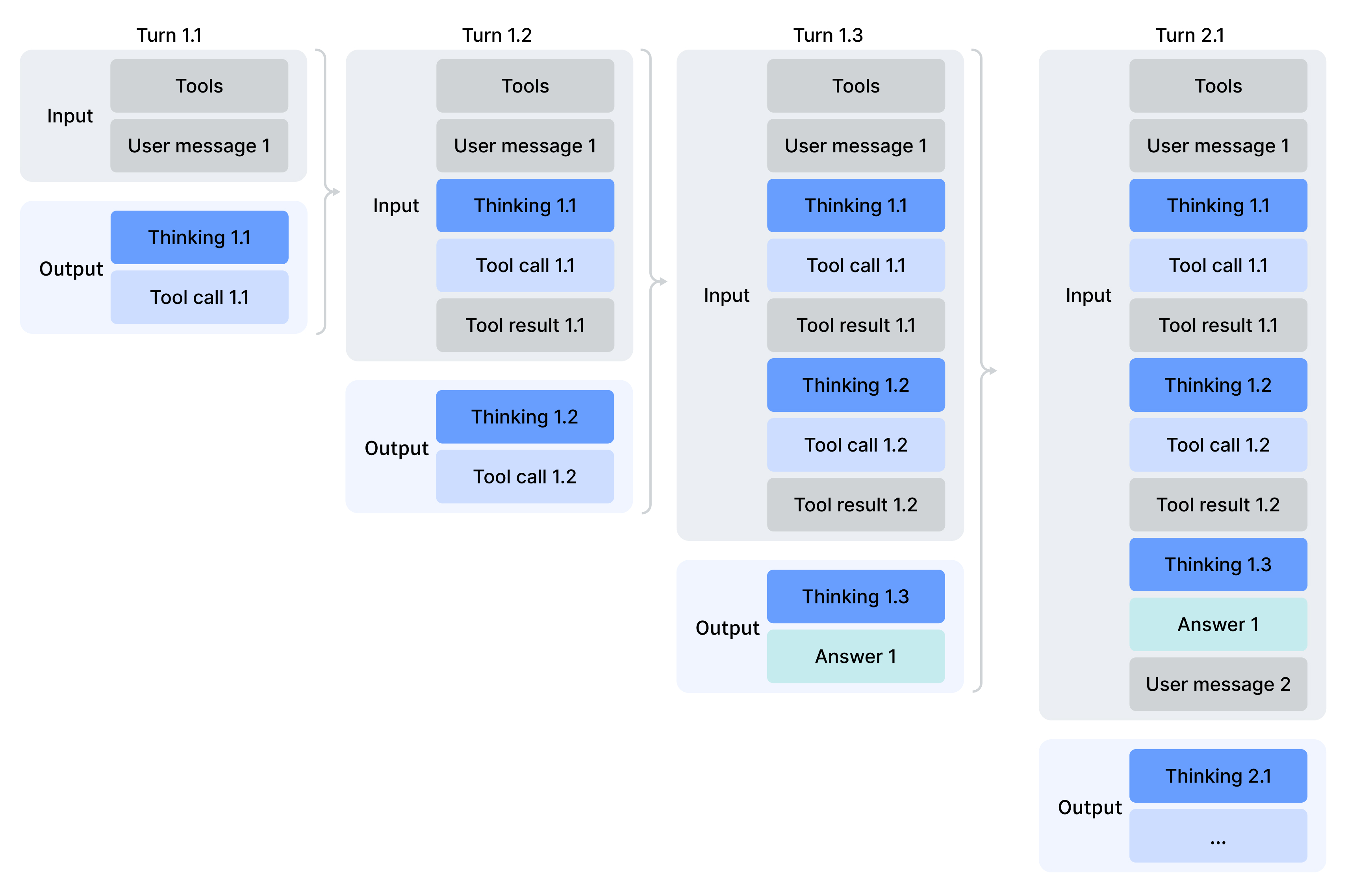
Please note that for requests carrying the tools parameter, the reasoning_content must be fully passed back to the API in all subsequent requests — even for turns where the model did not perform a tool call. If your code does not correctly pass back reasoning_content, the API will return a 400 error. Please refer to the sample code below for the correct approach.
Sample Code
Below is a simple sample code for tool calls in thinking mode:
import os
import json
from openai import OpenAI
from datetime import datetime

# The definition of the tools
tools = [
    {
        "type": "function",
        "function": {
            "name": "get_date",
            "description": "Get the current date",
            "parameters": { "type": "object", "properties": {} },
        },
    },
    {
        "type": "function",
        "function": {
            "name": "get_weather",
            "description": "Get weather of a location, the user should supply the location and date.",
            "parameters": {
                "type": "object",
                "properties": {
                    "location": { "type": "string", "description": "The city name" },
                    "date": { "type": "string", "description": "The date in format YYYY-mm-dd" },
                },
                "required": ["location", "date"],
            },
        },
    },
]

# The mocked version of the tool calls
def get_date_mock():
    return datetime.now().strftime("%Y-%m-%d")

def get_weather_mock(location, date):
    return "Cloudy 7~13°C"

TOOL_CALL_MAP = {
    "get_date": get_date_mock,
    "get_weather": get_weather_mock,
}

def run_turn(turn, messages):
    sub_turn = 1
    while True:
        response = client.chat.completions.create(
            model='deepseek-flash',
            messages=messages,
            tools=tools,
            reasoning_effort="high",
            extra_body={ "thinking": { "type": "enabled" } },
        )
        messages.append(response.choices[0].message)
        reasoning_content = response.choices[0].message.reasoning_content
        content = response.choices[0].message.content
        tool_calls = response.choices[0].message.tool_calls
        print(f"Turn {turn}.{sub_turn}\n{reasoning_content=}\n{content=}\n{tool_calls=}")
        # If there is no tool calls, then the model should get a final answer and we need to stop the loop
        if tool_calls is None:
            break
        for tool in tool_calls:
            tool_function = TOOL_CALL_MAP[tool.function.name]
            tool_result = tool_function(**json.loads(tool.function.arguments))
            print(f"tool result for {tool.function.name}: {tool_result}\n")
            messages.append({
                "role": "tool",
                "tool_call_id": tool.id,
                "content": tool_result,
            })
        sub_turn += 1
    print()

client = OpenAI(
    api_key=os.environ.get('DEEPSEEK_API_KEY'),
    base_url=os.environ.get('DEEPSEEK_BASE_URL'),
)

# The user starts a question
turn = 1
messages = [{
    "role": "user",
    "content": "How's the weather in Hangzhou Tomorrow",
}]
run_turn(turn, messages)

# The user starts a new question
turn = 2
messages.append({
    "role": "user",
    "content": "How's the weather in Guangzhou Tomorrow",
})
run_turn(turn, messages)
In each sub-request of Turn 1, the reasoning_content generated during that turn is sent to the API, allowing the model to continue its previous reasoning. response.choices[0].message contains all necessary fields for the assistant message, including content, reasoning_content, and tool_calls. For simplicity, you can directly append the message to the end of the messages list using the following code:
messages.append(response.choices[0].message)
This line of code is equivalent to:
messages.append({
    'role': 'assistant',
    'content': response.choices[0].message.content,
    'reasoning_content': response.choices[0].message.reasoning_content,
    'tool_calls': response.choices[0].message.tool_calls,
})
Additionally, in the Turn 2 request, we still pass the reasoning_content generated in Turn 1 to the API.
The sample output of this code is as follows:
Turn 1.1
reasoning_content="The user is asking about the weather in Hangzhou tomorrow. I need to get tomorrow's date first, then call the weather function."
content="Let me check tomorrow's weather in Hangzhou for you. First, let me get tomorrow's date."
tool_calls=[ChatCompletionMessageFunctionToolCall(id='call_00_kw66qNnNto11bSfJVIdlV5Oo', function=Function(arguments='{}', name='get_date'), type='function', index=0)]
tool result for get_date: 2026-04-19

Turn 1.2
reasoning_content="Today is 2026-04-19, so tomorrow is 2026-04-20. Now I'll call the weather function for Hangzhou."
content=''
tool_calls=[ChatCompletionMessageFunctionToolCall(id='call_00_H2SCW6136vWJGq9SQlBuhVt4', function=Function(arguments='{"location": "Hangzhou", "date": "2026-04-20"}', name='get_weather'), type='function', index=0)]
tool result for get_weather: Cloudy 7~13°C

Turn 1.3
reasoning_content='The weather result is in. Let me share this with the user.'
content="Here's the weather forecast for **Hangzhou tomorrow (April 20, 2026)**:\n\n- 🌤 **Condition:** Cloudy  \n- 🌡 **Temperature:** 7°C ~ 13°C (45°F ~ 55°F)\n\nIt'll be on the cooler side, so you might want to bring a light jacket if you're heading out! Let me know if you need anything else."
tool_calls=None

Turn 2.1
reasoning_content='The user is asking about the weather in Guangzhou tomorrow. Today is 2026-04-19, so tomorrow is 2026-04-20. I can directly call the weather function.'
content=''
tool_calls=[ChatCompletionMessageFunctionToolCall(id='call_00_8URkLt5NjmNkVKhDmMcNq9Mo', function=Function(arguments='{"location": "Guangzhou", "date": "2026-04-20"}', name='get_weather'), type='function', index=0)]
tool result for get_weather: Cloudy 7~13°C

Turn 2.2
reasoning_content='The weather result for Guangzhou is the same as Hangzhou. Let me share this with the user.'
content="Here's the weather forecast for **Guangzhou tomorrow (April 20, 2026)**:\n\n- 🌤 **Condition:** Cloudy  \n- 🌡 **Temperature:** 7°C ~ 13°C (45°F ~ 55°F)\n\nIt'll be cool and cloudy, so a light jacket would be a good idea if you're going out. Let me know if there's anything else you'd like to know!"
tool_calls=None